1. News:
Closing the gap between average and top sheep producers
The variation in gross margin between the nations leading 20% of sheep producers and average performing producers can be as high as 100%, providing a huge opportunity for increased profit in most sheep businesses. Capitalising on this opportunity has been the focus of Making More From Sheep for the last two years. Following an independent evaluation of achievements in the first phase of Making More From Sheep, co-owners Meat & Livestock Australia and Australian Wool Innovation have committed funding for a second phase over the next three years.
A key focus will be on addressing regionally specific needs of lamb, sheepmeat and wool producers to adopt better on-farm management practices for improving productivity, profitability and resiliance in sheep production businesses. Planning for the second phase is underway with administration to be overseen by MLA. Details of national and state co-ordination and delivery will be finalised over the next couple of months, with a new series of events and workshops likely to start around July. Keep an eye on the Making More From Sheep website for opportunities to get involved.
Exciting results from Longreach sire trial
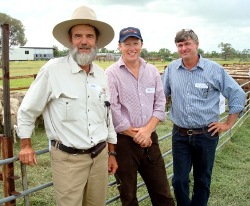
Sheep producers now have access to more pieces of the genetic puzzle after the release of results from Australia's northern-most Merino Sire Evaluation at a recent field day in Longreach. Over 30 producers attended Rosebank Research Station to view progeny from the trial and discuss results with Executive Officer of the Australian Merino Sire Evaluation Association (AMSEA), Ben Swain.
Progeny from the nine stud rams used were on display, with their performance able to be compared to other sire evaluation trials across the country through the use of link sires. Productivity traits measured in the Rosebank trial include yield, fibre diameter, staple length and strength, eye muscle depth, worm egg count and body weight. Visual traits including breech cover, body wrinkle, conformation, wool colour and dust penetration were also measured.
Results from the trial are available on the AMSEA websitewww.merinosuperiorsires.com.au or by contacting Andrea Hewitt at the Longreach DEEDI office on 07 46501225.
Photo: Sheep producer Jim O'Connell with AMSEA executive officer Ben Swain and trial site chairman Rick Keogh.
NFF 2010 Innovation Awards
The National Farmers Federation is calling for nominations for its second annual national innovation in Agriculture Awards, recognising and encouraging excellence in modern farming. The awards cover three categories (sustainability, value adding and new technology) and are open to all farmers who are full financial members of NFF member organisations - be they state farm groups, commodity or Associate Member groups. The 2010 Innovation in Agriculture Awards entry Guide - providing details and examples on each award, the criteria for entry and guidance on entry format, is available fromhttp://congress.nff.org.au/awards.html. Nominations close on Monday 31 May 2010.
2. R & D Update:
Subterranean Clover - keeping it in the system
Over time the subterranean clover content of pastures will tend to decline. This results in reduced animal production, a reduction in grass growth due to less nitrogen input and a buildup of annual broadleaf weeds. Re-establishing subterranean clover into existing pasture can be achieved by broadcasting or by direct drilling. Recent research by Dr Jim Virgona at the Holbrook EverGraze proof site has compared the methods. For key messages from his results click here to read a summary of the work written by Steve Clark and Anita Morant from DPI, Victoria.
3. In Brief:
Establishing a Photopoint
Photos provide a permanant visual record of change on your property without reliance on memory or taking measurements. For comparision, pictures should be taken at the same location, with the same direction, angle and focus points. Setting up semi-permanant photopoint sites allows you to monitor physical changes over time and prompts you to make the effort to do it. Tips on setting up different types of photopoints can be found in Tool 5.12 in the Making More From Sheep manual.
Getting started in simple rotational grazing
The good autumn break in many areas of eastern Australia provides an excellent opportunity for set stockers who are interested to trial rotational grazing. All perennial species will be more productive and persistent under grazing that includes rest periods. The way a pasture is grazed also affects how evenly nutrients in dung and urine are distributed and recycled throughout a paddock. Tool 8.7 in the Making More From Sheep manual describes a simple approach that can be used to trial a 4 paddock rotation system.
4. Coming Events
Over 5000 sheep producers have attended events on various Making More From Sheep modules. These events may be small workshops, large seminars or webinars (a seminar that you attend on your computer and phone without leaving home). The one thing these events all have in common is that after participating you will be able to implement at least one of the management practices or tools from the Making More From Sheep manual on your property.
Events for the new phase of Making More From Sheep are currently being planned and will be posted on the events page of the website once they are finalised. In the meantime, the Sheep CRC is running a series of webinars as follows:
April 29 - OFFM calculator
April 30 - Pedigree Matrix
May 4 - Ram value calculator
Visit the Sheep CRC Events page for more details.
|